Common Mistakes in Solar Site Surveys
The U.S. Department of Energy shows that so-called “soft costs” including permitting, design, and installation processes make up a significant portion of total system cost and are heavily influenced by…

Insights
The average solar sales rep spends over 10 hours a week just creating proposals. That’s more than a full workday lost - not selling, not following up, but building quotes.
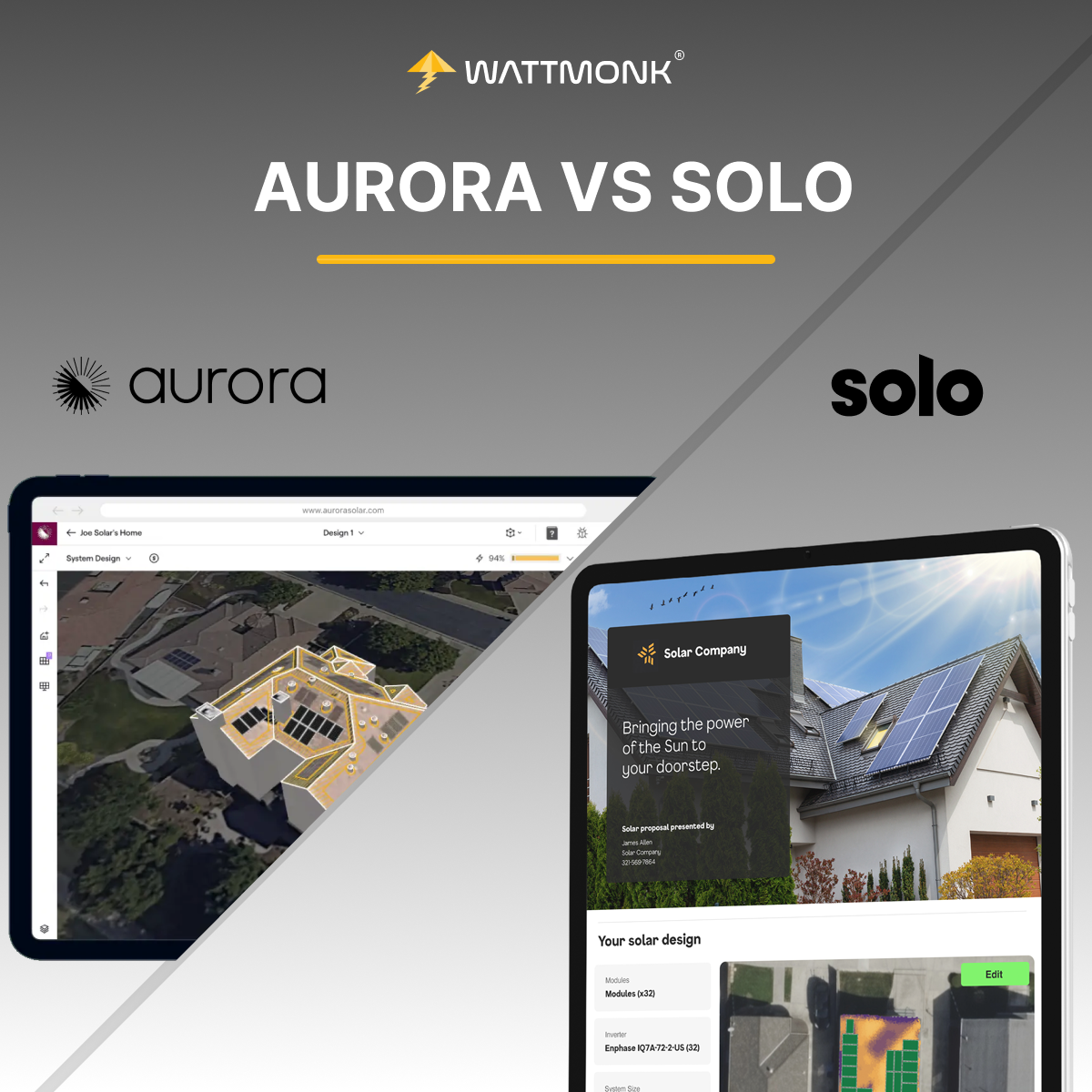
In a market that moves fast and expects faster responses, proposal time is critical. That’s why tools like Solo solar software and Aurora Solar have become essentials in the solar sales stack. But while both aim to speed things up, they cater to very different needs.
Solo solar software is designed for sales teams that prioritize speed and simplicity. Aurora, on the other hand, offers a robust suite of design and engineering features that can power even the most complex solar projects.
So which one should you choose in 2026?
In this blog, we compare Solo vs Aurora on usability, speed, accuracy, and ROI - and explain why many solar companies are skipping the tool decision altogether by partnering with Wattmonk, where Aurora is already built into our proposal workflow.
Solo solar is a cloud-based, sales-driven solar proposal platform tailored for speed, simplicity, and scale. Unlike engineering-first platforms, Solo solar proposal software is designed to empower non-technical sales reps to produce full proposals quickly—without needing CAD or shading expertise.
Solo solar software generates proposals in minutes using address-based data input and its production engine—claimed to deliver utility-grade forecasts that meet audit and lender compliance standards.
Solo solar proposal platform includes automated shading and production calculations at the per-panel level, based on satellite imagery and TSRF metrics—now directly visible in the system via June 2026 updates.
With built-in support for real-time financing options and tools like SoloSign for digital document execution, it creates a seamless proposal-to-close experience.
Solo solar software offers CAD turnaround in 24 hours or less, permit assistance, and branded proposal templates—perfect for teams that want polished collateral without building internal design workflows.
New features like a “Professional Support” tier, weekend support availability, and multi-installer account handling promote flexibility for growing solar businesses.
Solo solar design software is built for solar sales teams who prioritize:
Limitation
Considerations
Not engineering-first
Lacks full 3D layout, LiDAR, or advanced shading-based modeling features
Solo soalr pricing not fully transparent
Has per-proposal and usage fees; costs vary by volume and support layers
Scope for technical complexity limited
Best for simpler residential projects; may fall short for multi-surface roofs or atypical installation scenarios
Aurora Solar is a professional-grade solar design and proposal platform trusted by over 7,000 solar companies globally — including top EPCs, developers, and engineering teams. Unlike Solo solar software, which focuses on proposal speed, Aurora was built to offer technical depth, design flexibility, and advanced modeling accuracy, making it the go-to software for both sales and engineering workflows.
Whether you're designing a complex commercial PV system or customizing residential proposals with real-time utility rates, Aurora brings utility-grade precision right into your browser.
Aurora lets users build 3D models of rooftops, trees, and obstructions using HD imagery, LIDAR data, and AI-assisted tools — resulting in highly accurate production forecasts.
Uses industry-validated irradiance models like PVWatts and SAM to generate performance simulations that align with NABCEP and utility standards.
Automatically pulls current utility tariffs, TOU rates, and Net Metering rules across jurisdictions to forecast savings more accurately.
Aurora includes string sizing, inverter configurations, and automatic NEC checks for code compliance.
Combines its engineering-grade modeling with sleek, customizable proposals that reflect real system behavior — not just estimates.
Supports robust integration with Salesforce, Zoho, HubSpot, and financing partners like Mosaic, Sunnova, and GoodLeap.
Aurora is best suited for solar businesses that need:
Limitation
Considerations
Learning curve
Takes time to master - especially for sales reps with no technical background
Higher cost
Pricing is premium-tier with per-seat licenses (annual)
Requires detailed input
Best used when site details, shade profiles, and electrical needs are clearly defined
Below is a side-by-side breakdown of how each platform performs across the most critical areas for solar sales and system design:
Feature
Solo Solar Design Software
Aurora Solar
Proposal Speed
Ultra-fast turnaround (often <30 mins)
Slower due to design input requirements
Ease of Use
Extremely user-friendly for non-technical users
Steep learning curve for sales reps
3D System Design
Not supported
Full 3D modeling with LIDAR & AI
Shading & Irradiance Modeling
Basic or estimated shading via imagery
Industry-grade shading tools (TSRF, LiDAR, PVWatts, SAM)
Utility Rate Integration
Limited
Dynamic real-time rates, TOU, NEM
Proposal Customization
Strong templating, branding, and mobile-friendly proposals
Fully customizable with production-based estimates
Engineering Tools (NEC, Strings)
None
String sizing, inverter layout, NEC compliance
CRM & Financing Integration
Salesforce, Sunlight, Mosaic, etc.
Deeper API options + 3rd party integrations
Best For
Small sales teams, fast-quoting operations
Design-forward teams, AHJ-ready proposals, commercial installs
Both Solo solar software and Aurora Solar are strong tools — but they solve different problems for different teams. The right choice depends on what stage your business is in, how technical your team is, and what level of accuracy your proposals demand.
Here’s a quick run-down to help you:
But keep in mind: if you ever need AHJ-ready plans or utility approvals, Solo may fall short and you’ll need to rework proposals using another tool or third-party support.
Aurora gives you complete control but it demands more time, technical expertise, and budget.
If you want Aurora-level accuracy without:
…then the best option might be letting Wattmonk do it for you.
We use Aurora Solar for creating compliant, lender-ready sales proposals and even full design packages. You get the output — minus the overhead.
Whether you’re using Solo solar, Aurora, or nothing at all, Wattmonk plugs into your process and delivers the results faster, cleaner, and with fewer revisions.
Explore Related Insights
Dive into our meticulously selected articles that provide insights on sustainable practices and eco-friendly strategies for brands.